Vision & Mission

Vision: A peaceful and just country in which freedom, human and democratic rights of all people are assured.

Mission:To work in partnership with different target groups to educate, mobilize and advocate to build a society of rights conscious citizens and a political culture that enables a political solution to the ethnic conflict and equal opportunities to all.

Wednesday, January 25, 2012

LLRC REPORT AND PRESSURES FROM TAMIL CIVIL SOCIETY


The TNA has yet to issue its follow up response to its initial rejection of the report of the Lessons Learnt and Reconciliation Commission.  In a strongly worded statement the TNA noted that “The report of the LLRC is a serious assault on the dignity of the victims of the war in Sri Lanka, and as such, has not only gravely damaged the chances of genuine reconciliation but has further alienated the victims of the war.” It therefore called on the international community “to acknowledge the consistent failure of domestic accountability mechanisms in Sri Lanka and take steps to establish an international mechanism for accountability.”

However, the initial responses of international governments towards the report have been by and large favorable, especially with regard to the many recommendations on governance and on a political solution that would address Tamil grievances. There are many among the international community who are not aware of the past history of Tamil grievances and broken promises.  They are likely to be puzzled by the apparent total rejection of the LLRC report by the TNA.  They are likely to see an excessively demanding attitude asking for too much.  In responding to the LLRC report, the TNA appears to have considered the expectations of its supporters in the Tamil Diaspora as well as its voters.Â

The TNA's rejection of the LLRC report would seem to have arisen from the principal concerns of the Tamil populace it represents to come to terms with what happened during the last phase of the war.  One key factor is the Tamil Diaspora.  Sections of the Diaspora are not reconciled to the defeat of the LTTE and what it means in practice.  The LTTE kept the hope of an independent state of Tamil Eelam alive.  When the military strength of the LTTE was at its height, there was an increased willingness on the part of the Sri Lankan governments that had to deal with it to pay a price for peace.  This included extensive devolution of power and the merger of the Northern and Eastern provinces.

Even today the nationalist section of the Tamil Diaspora is able to sway Tamil opinion within Sri Lanka to take positions that were common during the war period.  Their was seen in a statement of several leading civil society figures who critiqued the TNA for not being sufficiently committed to positions such as self determination, Tamil nationhood and the merger of the North and East. This group was critical of US and Indian government positions with regard to accepting the post-war reality of accepting the provincial council framework. This statement titled Public Memo to Members of Parliament representing the Tamil National Alliance from members of Tamil Civil Society and issued on December 13, 2011 originated from the nationalist camp who wish to score one over the TNA.


GRASSROOTS PRESSURE

There is also the pressure from below on the TNA that come from its own voter base in the former war zones of the North and East.  The LLRC report has come as a disappointment to those who experienced the full brunt of the war.  This section of the TNA's constituency had hopes about the LLRC that belied its mandate.  It seems that many victims of the war believed that the LLRC would actually give them immediate solutions to their problems.  The chief amongst these problems are finding out what happened to their loved ones who went missing and being compensated for what they had lost.

The LLRC received a positive response wherever they went.  Most of its sittings were in Colombo where many eminent personalities and well known organisations made presentations before it.  The demand was so high that the LLRC had to restrict the time they gave to many of them, although it made a positive attempt to accommodate all who applied to be heard.  The National Peace Council of which I am a member was one of those civic organisations.  The LLRC gave us a limited time and not all our members could speak.  Some of our members made written representations.  But we left the meeting feeling that we had we had been heard.

The LLRC also had sittings in all of the districts of the North and East where the war was fought.  It was clear that in these areas especially, the demand for the time of the LLRC far outstripped its availability.  In some places like Kilinochchi, where the most decisive battles were fought, there were literally thousands who asked to make their statements.  But only a fraction of them could be accommodated to give evidence before the Commissioners personally.  The others were given the option of making written submissions.

The thousands who sought to give evidence before the LLRC in the North and East did not do so simply to provide it with information for analysis and posterity.  They also wanted their problems solved.  Faced with the absence of any alternate problem-solving governmental mechanism, they were hoping that their detailed evidence would help the LLRC to find out what had actually happened to their loved ones.  They wanted to know if those who were missing were alive or dead, and if alive where they were.  They also wanted to get adequate compensation for their lost property and livelihoods to make a fresh start.


DIFFICULT MANDATE

On the other hand, the LLRC's mandate was difficult.  It was not to investigate and find solutions to the problems of individuals.  The LLRC was not equipped with the investigative machinery for this endeavor.  Investigating even a single case of disappearance is a task requiring much effort on the part of investigating officers who have to get the statements from all those possibly implicated in a disappearance.  There is a need to sift evidence and take it before appropriate judicial authorities before a verdict can be given.  This was not a practicable task for the LLRC given that there were thousands of such cases before it.

Sri Lanka has had adequate experience in responding to practical problems arising out of a large scale destruction of property and loss of life in a short space of time, such as the Tsunami of December 2004.  Here the government responded effectively to enable those who were bereft of all their possessions and documentation to speedily reestablish their legal status.  The issuing of documentation in relation to the many who simply disappeared was also done with speed of accommodation.  A similar system could have been adopted in the immediate aftermath of the war to deal with practical problems of the populace, and can still be adapted to give succour to those who have suffered much.  Constructive actions by the government could help the TNA to steer the middle ground as called for by another Tamil civil society group last week.

A statement issued by a prominent group of Tamil civil society leaders recently on January 7, 2012 states that with the end of the war, it has become important for all ethnic communities of Sri Lanka to re-examine and re-evaluate their past.  They have raised the question of the eviction of the Northern Muslims by the LTTE two decades ago.  They stated that “The eviction represents one of the worst instances of the narrow, exclusivist thrust of the Tamil nationalist political campaign of the past thirty years. The failure of our civil and political leadership to understand and acknowledge this has prevented us from dealing with our own past, and with our own moral and political responsibility towards minority communities that live amidst us. An examination of how we have contributed to the polarisation of relations between our two communities has not been forthcoming even after the end of the thirty-year war.”

The call they make to the Tamil community is to “realise at least now that there is no exclusive political solution for the Tamil community, and that the question of political power sharing and equal rights confronts all minority communities.”  This same analysis applies to the larger issues that the Tamil community is confronted with today.   In the context of this civil society appeal, there is a need for the political representatives of the Tamil people, most importantly, the TNA, to reconsider their initial outright rejection of the report of the Lessons Learnt and Reconciliation Commission.  The report of the LLRC would count as amongst the most important official and public documents that investigates and analyses the causes of the ethnic conflict and problems of governance in the country.

TAMIL POLITY AND LLRC REPORT


The main political representatives of the Tamil people, the MPs of the Tamil National Alliance, have been under pressure from the government which frequently refers to them as the “LTTE rump.”  During the latter period of the three decade long war, the LTTE was able to persuade the TNA politicians to fall in line with their position that the LTTE was the sole representatives of the Tamil people.  Prior to this capitulation, several leading politicians from constituent Tamil parties had been assassinated by the LTTE, leaving those who survived with little alternative option.  Some either joined the government or stopped criticizing the government in order to obtain government security to protect their lives. Those who preferred to remain independent of the government made the choice of falling in line with the LTTE.

President Mahinda Rajapaksa is one of the government leaders who frequently refers to the TNA as holding on to LTTE positions.  He has appealed those perceived as being influential in regard to the LTTE, such as the Indian media, to convince the TNA to be reasonable and to discuss how to resolve the problems of the Tamil people with the government.  There is a section of the government that sees the TNA as being unreasonable in continuing to insist on old positions held by the LTTE, such as the merger of the Northern and Eastern provinces.  But the LTTE also held on to the notion of an independent Tamil state and sought to achieve it through violent means.  By way of contrast the TNA has been the victim of violence by all sides and holds to the ideal of a federal Sri Lanka, which fall short of independence.

The situation that the TNA finds itself in today is not enviable.  The TNA is not only under pressure from the government.  It is also under pressure from the Tamil people who voted for it by large majorities in the areas in which Tamils predominate. The majority of those who voted for the TNA would be amongst the worst off in Sri Lankan society.  They lived in the midst of war that despoiled the North and East of the country for nearly three decades.  Only few of them were unscathed by the disaster that unfolded during that long period.  Invariably the war entered their lives, either by collateral damage, having their children forcibly recruited or being forced to flee from one place to the other.

Even today more than 100,000 Tamil people live displaced and outside of their homes, either with relatives or in transit camps awaiting relocation to their home areas.  They would be seeing the peace dividend in the form of government buildings that are coming up and roads being repaired and tourists from the rest of the country traveling along them.  But unfortunately for most of them these developments remain outside of their reach, as those contractors who build the government buildings and roads come from outside the North and East for the most part, and bring their own labourers with them.  Even the tea kiosks by the side of the road are manned by army personnel which means that the people who could have done that small scale enterprise are denied that opportunity as well.


CONSTRUCTIVE POLITICS

So far the TNA has failed to persuade the government to deliver more resources to the people of the North and East.  In a democratic polity where politicians need votes of people to remain in power, it is inevitable that governments in power would prefer to allocate scarce economic resources to those who will vote for them.  As the TNA does not support the government and instead engages in confrontational politics with it, the government is not inclined to be responsive to the needs of people who vote for the TNA.  This keeps in motion a vicious cycle of neglect and hatred that is not good either for reconciliation in the country or for the people in the North and East.

As the political representatives of the war-affected Tamil people, the TNA has to consider engaging in politics that helps the people rather than leads to their neglect.  On the one hand, it is important for the TNA to keep the aspirations of the Tamil people in mind. It is also important that the basic needs of the people are also met so that lead a normal life in which there is material progress for themselves and their children.  The TNA needs to reconsider their apparent policy of total confrontation with the government at all levels.   As a beginning in the process of reconciliation with the government, the TNA could reconsider their strong rejection of the final report submitted by the Lessons Learnt and Reconciliation Commission to the President.

The report of the LLRC would count as amongst the most important public documents that investigates and analyses the causes of the ethnic conflict and problems of governance in the country. However, the TNA’s preliminary statement on it echoed that of international human rights organizations which strongly critiqued and rejected the LLRC report.  Earlier they had found fault with the composition of the LLRC and now they found it wanting in terms of international humanitarian law.  However, the TNA is not an international human rights organization but a political party.  Politics has been defined by those skilled in the profession as the art of the possible.


COMMENDABLE PRESCRIPTIONS

The TNA’s preliminary statement rejecting the LLRC report focused on its failure in holding the government accountable for human rights violations and war crimes and for attempting to pass them on to the failures of individual soldiers.  It stated that “The LLRC report categorically fails to effectively and meaningfully deal with issues of accountability.”  The TNA statement did not consider the LLRC’s analysis of the causes of the conflict and its prescriptions for the resolution of the conflict.  What the LLRC had set out in terms of good governance practices and a political solution was not new, and has been stated by the more liberal and thoughtful politicians and civil society groups on numerous occasions before.  But what was special this time was that the LLRC was appointed by President Rajapaka whose government has taken a diametrically opposed position on almost all of the issues addressed.

The government’s decision to make the LLRC report public could be due to a variety of reasons.  In the case of previous commissions of inquiry that seemed to come up with inconvenient truths, the government either stopped them three-quarter way or suppressed their findings, as in the case of the report of the All Party Representatives Conference on a political solution.  On this occasion there was considerable international pressure on the government to come out with the report, as the government itself held out that the LLRC report would provide the answer to international allegations of war crimes in the last phase of the war.  This is an opportunity to be taken and not rejected.  Although the TNA may find fault with how the LLRC addressed the issue of accountability, its analysis of the conflict and its prescriptions have much to commend in them.

As the third largest political party within Parliament and the largest Tamil one, the TNA needs to consider joining hands with the other political parties and with like-minded civil society organizations to ensure that the LLRC recommendations are implemented.  While the government has given the impression that it accepts the LLRC report, its decision making circles may believe it is not in their interests to implement the recommendations any time soon.  The LLRC’s vision is that of a plural and multi ethnic society in which there is the rule of law and checks and balances on unbridled power.  As a result it is possible that the government leadership will prefer to drag their feet when it comes to implementing the recommendations of the report.  It is important that the Tamil polity become a vibrant one that is integrated into the larger national polity.  It is in the larger national interest that the LLRC recommendations be implemented.

IMPLEMENTING LLRC REPORT IN NEW YEAR WILL BE THE CHALLENGE

The 388 page report of the Lessons Learnt and Reconciliation Commission appears to be earning more bouquets than brickbats.  Even one of the government’s foremost critics, the International Crisis Group, has noted its positive contribution to affirming principles of good governance and a political solution to the ethnic conflict. However, it has expressed strong dissatisfaction with the Commission’s findings on accountability.  ICG was one of a trio of international human rights NGOs that were invited to make representations before the LLRC but refused to do so.  They found fundamental flaws in the composition of the Commission, which consisted mostly of former government officials, and also in its mandate, which was too restrictive in terms of investigating human rights violations.

The two other international human rights organizations have also commented on the LLRC.  Together with ICG, Amnesty International and Human Rights Watch have taken a common position that there continues to be a need for an independent international investigation into the issues of human rights violations and war crimes.  So far, the response of international governments has been rather muted.  The United States government which, has been one of the first foreign governments to respond, has said there are gaps in the LLRC report.  The US has also noted that the Commission has addressed a number of the crucial areas of concern to Sri Lankans, in particular in the areas of reconciliation, devolution of authority, demilitarization, rule of law, media freedom, disappearances, and human rights violations.

With regard to an independent international inquiry the US State Department spokesperson has expressed the view that “it is better for Sri Lankans to take these issues themselves and address them fully. That remains our position, so now we want to see if the Sri Lankan Government will lead their country in the next step to ensure that there is full implementation of the recommendations that we have and filling in of the gaps.”  When pressed to the wall either by terrorism (as in the World Trade Centre attack in New York) or by their compelling geopolitical interests (as in Libya) international governments have not hesitated from resorting to drastic and violent measures that result in collateral damage to civilians. 

Governments operate within the realm of the possible, while NGOs express the ideal and seek to push governments in that direction. The Sri Lankan media recently carried a news item citing Norwegian Defence Minister Espen Barth Eide, responding to a New York Times (NYT) exclusive that it had obtained evidence to prove the NATO air campaign in Libya claimed the lives of civilians. He emphasized that Norway’s aim was to operate within International Humanitarian Law (IHL). The minister was reported to have declared that it was wrong to assert IHL was violated because of civilian losses unless something unacceptable took place during a conflict. This is also the point of dispute where the Sri Lankan government has been at loggerheads with a section of the international community.


GOVERNMENT RESPONSE 

The Sri Lankan government’s initial reaction to the LLRC report was positive.  Minister Nimal Siripala de Silva who presented the report to Parliament on November 16 said that it is of great importance to the government to have the truth relating to the death of civilians in the last phase of the war established in a manner that puts the controversy to an end for all time.  He also said that the government has asserted on many occasions that if reliable evidence was available the law of the land would be set in motion.  However, President Mahinda Rajapaksa has not yet commented on the report.  The LLRC itself has noted that recommendations made by previous commissions of inquiry had not been implemented. The failure of the government to implement even the LLRC’s own interim recommendations in a conclusive manner had led to an exacerbation of the problem of credibility. The challenge is to ensure that there will be governmental follow up to the final recommendations of the Commission. 

The Commission has accepted the government’s position that military operations were conducted with the highest priority being given to issues of civilian safety. At the same time it has also found evidence of violations of international law in the conduct of military operations in several instances and has asked that these incidents be inquired into.  However, apart from piecemeal investigations into individual incidents that could be done fairly soon, there is also the need for a comprehensive accounting of the past that could take a longer period of time.  A Truth and Reconciliation Commission to go more deeply into the entire tragedy of the war could be a longer term mechanism to ensure that victims are heard, their grievances addressed, compensation given and perpetrators identified and provided with an opportunity for repentance and amnesty.

Practically the possibility of a full accounting of what happened in the whole course of our thirty year war would only come when the government is headed by those who had nothing to do with the war.  This is the experience internationally as well where internal processes for accountability and truth seeking are concerned.  If Sri Lanka hopes to gain its place amongst the respected countries in the world with regard to the practice of human rights in the future, the government is obliged to hold individual members of its armed forces and government members accountable for their violations even if justifications are available and provisions for amnesty are made available. The experience of other countries is that such an accounting usually takes decades and more.  


FOLLOW UP 

The LLRC report deals with much more than the killings and disappearances that took place during the war.  It also deals with issues of governance that have contributed to the loss of confidence of people in democratic institutions and induced them to violence.  The centralization of power, and disregard for the rule of law, has reached an apogee with the passage of the 18th Amendment to the constitution with abuse of power and corruption also reaching high levels. Among its many recommendations, the LLRC has advocated the removal of the police department from the Ministry of Defence.  It has also recommended that the police be placed under an independent commission. This refers back to the practice under the 17th amendment which was effectively repealed by the 18th amendment which further concentrated power inadvisedly in the Presidency. 

The experience of other countries in which there are conflicts between ethnic communities shows that these problems have to be consciously dealt with.  The problem is that governments that are in a dominant position seldom see a need for reform. It is on the issue of a political solution that would address Tamil grievances that the LLRC has made its most commendable stand which places it in a different frame of thought as compared to what the present government leadership in particular has been asserting.  But without such reform there cannot be lasting peace as the LLRC report implies.  The report of the All Party Representatives Conference headed by Prof. Tissa Vitarana which was submitted to the President last year would be a suitable starting point in finding a political solution. Unfortunately this report which was over two years and over a hundred meetings in the making has still not been released to the public by the President who appointed the committee. 

Such an action can dispel concerns that the LLRC report will suffer the same fate of countless other commission reports and fail to be implemented.  Although the government has won itself a breathing space from the international community due to the LLRC report, it cannot rest on its laurels.  The Tamil political parties remain deeply skeptical of the government.  The Tamil people who were the victims of the war are concerned that the report will make no quick difference to their lives.  The government’s New Year resolution needs to be to undertake reform and reconciliation with a sense of urgency in the coming year itself, and not leave it for the succeeding years or the next government.  As a follow up to the Commission report the government would do well to appoint a Presidential Task Force of independent persons selected with the concurrence of the opposition to oversee the implementation of the Commission’s recommendations.

Wednesday, September 21, 2011

International Peace Day 2011 celebrations


Youth United for Peace and Reconciliation

Mihasa Foundation: Youth for Peace, a group of undergraduates from University of Kelaniya, Sri Lanka organizes lectures on current trends on peace and reconciliation in Sri Lanka, launch of the Mihasa website, launching of the Mihasa website and the newspaper and a documentary screening.  125 undergraduates and secondary school students will be participating in order to build a culture of peace by taking it to a new generation of global citizens in Sri Lanka. National Peace Council supports this event by providing its financial and intellectual resources.  This will be held at National Library auditorium from 8.30 a.m to 1.00 p.m.


Exchange visit of religious and civil society leaders from South to North
 
Religious and civil society leaders representing 8 District Inter religious Councils established by NPC with EU support will visit and IDP camp, donate school books, donate school books to war-affected children, discuss and share experiences with the war -affected people, visit historically important places. 400 war affected children from Mannar, Jaffna and Vavuniya and 30 religious leaders and 70 civil society leaders from 8 DIRCs including North and South are expected to participate for the International Peace day celebrations. This will be held at the Tharanikulam ganesh College in Vavuniya from 9.00 a.m. to 12.30 p.m. and is organized by Centre for Peace and Reconciliation in Jaffna.

Monday, September 12, 2011

UNIFYING TASKS FOR A FUTURE NORTHERN PROVINCIAL COUNCIL --Jehan Perera


The government media gave headline prominence to the fact that Sri Lanka has made an impressive jump of 10 places to 52nd from 62nd in the rankings of the latest Global Competitiveness Report (2011-2012) issued by the World Economic Forum (WEF).  This is a further improvement from the 2009-2010 report which ranked the country at 79th position while last year’s report placed Sri Lanka in the 62nd spot.   Sri Lanka shows improvements on 80% of indicators - 80-90 of the 110 indicators - both in terms of scores as well as rank.  Sri Lanka made the greatest improvements in scores, year-on-year, in the pillars of macroeconomic stability, infrastructure and security, which the WEF noted was remarkable, and attributed it to the improved climate following the end of the war.

On the other hand, one of the major disappointments of Sri Lanka’s post-war progress is that these impressive economic achievements have not been accompanied by similar success in achieving reconciliation.  Ethnic polarization and hard feelings across the party political divide continue to take centre stage, and put the brakes on what could be outstanding success.  The government’s position is that a united and prosperous Sri Lankan nation can be built through the inspired leadership of President Mahinda Rajapaksa and his close associates whose abundant talent no one can deny.  One manifestation of this position was the 18th Amendment passed earlier this year which centralized power further in the already too powerful presidency.

In conformity with its centralizing of power, powerful government decision makers have declared that no further constitutional change is necessary to increase the devolution of power.  This has been a cause of controversy and polarization.  There has been an equivalent reaction from the opposition Tamil political parties, and also sections of the international community, that the government’s war time promise of further devolution of power needs to be delivered.  During the height of the war, President Rajapaksa made numerous promises regarding the government’s post-war intentions with regard to the devolution of power.  The most famous of these was his declaration that he would implement a political solution that would be the 13th Amendment plus one.

This enigmatic statement of the President was taken to mean that he would ensure the full implementation of the 13th Amendment that had led to the establishment of the system of devolution based on the provincial councils.  At the least it was taken to mean the devolution of powers that are contained in the 13th Amendment, but which had never been devolved, specifically land and police powers.  A more hopeful reading included the apportioning of subjects in the concurrent list entirely to the provinces, rather than continuing to share them between both the centre and provinces with the central government monopolizing them.  This would have gone at least part of the way to meeting the TNA’s demands regarding the enhanced devolution of power as a solution to the ethnic conflict.


NORTHERN COUNCIL

While the government is now saying that no land or police powers can be granted, the TNA is demanding them and also calling for the re-merger of the Northern and Eastern provinces.  The gulf that exists between the positions of the government and TNA can become paralyzing, which is what appears to be the current situation.  There is no movement forward that is bringing the parties together.  On repeated occasions the government has shown its political strength with the ethnic majority by winning elections in a convincing manner in most parts of the country.  But it has been failing to do that in the Tamil-majority parts of the Northern and Eastern provinces where the TNA has won. 

There can be no forward movement in terms of ethnic reconciliation without these two parties reaching agreement.  The government’s latest proposal for forward movement is to establish a Parliamentary Select Committee that would enable all parties in Parliament to discuss the issue of a political solution that would strengthen the unity of the country.  However, the TNA sees in this an insincere effort of the government to delay negotiations with it regarding a political solution, even though the government has agreed to a time frame of six months.  It has so far not agreed to join in the deliberation of the Parliamentary Select Committee.

There are some confidence building actions that the two sides can be urged to take on by those with an intention of fostering a meeting of minds.  The government has recently demonstrated its willingness to engage in confidence building by lifting the State of Emergency.  The fact that the government ended rule by emergency regulations in the run-up to the meetings of the Human Rights Council in Geneva suggests that the government is sensitive to the demands emanating from a section of the international community with regard to normalization after the end of the war. Most of the countries that are putting pressure on Sri Lanka had a tacit understanding with the Sri Lankan government that the war’s end would bring normalization and a political solution.

A confidence building measure that the government could take with respect to moving forward in the political process would be to announce the date for the conduct of provincial council elections for the Northern Province.  So far it is only the people of the Northern Province who have been deprived of the benefits of provincial level devolution.  They need to enjoy the same rights and privileges in respect of devolution of power that the people in the rest of the country enjoy.  The establishment of a Northern Provincial Council would also enable the people there to experience the workings of the devolved system and clarify their priorities.  It would permit the future Chief Minister of the Northern Province to sit with colleagues from the other provinces in the Chief Ministers Conference and provide them with partnership, insight and leadership.


FISCAL DEVOLUTION

There will be a very important and unique contribution that a future Northern Provincial Council can make to the entire scheme of devolution of power in Sri Lanka.  At the present time all the provincial councils are controlled by the government.  This includes the Eastern Provincial Council which is headed by the TMVP, which is a coalition ally of the government.  There is hardly any impetus for reform coming from the present leadership of the provincial councils as none of them would wish to displease the government.  However, in the event of a Northern Provincial Council being established, it will most likely be headed by the TNA.  This would give the TNA an opportunity to provide leadership in regard to improving the system of devolution of powers for all provinces.

A key area of devolution of power where a future Northern Provincial Council could give leadership would be fiscal devolution.  At the present time, the proportion of the national budget that goes towards the functioning of the provincial councils is too small to enable them to do anything much more than pay salaries and maintain the infrastructure they already have.  This is why teachers and parents of schools that are on the provincial list are glad when the central government takes them over as national schools.  They believe that they will get more resources through the central government than through the provincial council.  This imbalance needs to be changed for the devolution of power to become effective.

Unfortunately, instead of empowering the provincial councils by providing them with more resources, the government has been debilitating them. The last budget saw the internal fund-raising capacity of the provincial councils further weakened when the Business Turnover Tax was removed from their purview.  This taxing power was transferred to the central government. There is a need for leadership from within the provincial councils themselves to demand more fiscal devolution. This can be the confidence building task of a future Northern Provincial Council, if and when it is established. There is the possibility of getting across-the-board support from all provincial councils for fiscal devolution which will be good for national unity and for the effective functioning of devolved government.

Dispossessing And Disempowering The People By Tisaranee Gunasekara


make us development orphans”. A slogan at the September 6th protest against Rajapaksa land-grabbing
The Rajapaksa plan to evict almost 70,000 poor families from Colombo and sell/lease their lands to favoured bidders has been put on the backburner – until the Colombo Municipal Council election is over. A protest which took place last week demonstrated that land-grabbing is not the exclusive problem of Colombo’s poor. With actual and potential victims belonging to all ethnic and religious groups, from both urban and rural areas, land-grabbing by the state in the name of national security and development has become a truly Sri Lankan malaise.
The demonstrators, farmers and fishermen, clergy and environmentalists, highlighted a plethora of issues: Kalpitiya islets leased to tourism-promoters, endangering the livelihoods of traditional fishing-communities; large-scale land expropriation in the East to build hotels, a navy camp and a power station; a sea-plane project involving 20 inland reservoirs which can devastate fishing and farming communities and the environment; maize and sugar cane cultivation in Uva Wellassa; banana cultivation in Somawathiya; threats to Sinharaja and the Knuckles Range…  Story after story of dispossession, deprivation and displacement; every one of them resulting from a politico-economic strategy which regards ordinary Lankans, the people, as insignificant, unimportant and expendable.
The initial manifestations of this dismissive attitude towards ordinary Lankans happened in the context of the Fourth Eelam War. The myth of a humanitarian operation was premised on denying and belittling the very heavy price ordinary people in the war-zone were compelled to pay. The war was waged, by both the LTTE and the regime, nominally for and on behalf of the Tamil people but in actuality as if they were a negligible quantity, a bagatelle deserving no consideration.
The latest batch of Wikileaks cables details the briefing given by the UN Secretary General to the Co-Chair Ambassadors in Colombo, subsequent to his May 2009 visit to Sri Lanka. In response to a question about conditions in the Menik Farm, Mr. Ban stated that “his visit there had been ‘very sobering and very sad’. He said the conditions were worse than those at any other camps, including in Dafur and Goma that he had visited, and noted that he had seen signs of malnutrition. Asked about his flyover over the No Fire Zone, Ban described seeing ‘complete devastation’…” (Colombo 000567). The fact that Mr. Ban decided not to make his explosive observations public proves that he has no axe to grind. His obvious intent was to work with rather than against the Rajapaksas. Thus his understatedly anguished remarks about the human costs of the war carry weight and conviction.
The indifference to human cost, the lack of transparency, the no-holds-barred maximalism which characterised the Rajapaksa war-effort are percolating into the South and becoming key features of the regime’s economic strategy. This transposition is evident in the way the regime is expropriating land, secretively, often using extra-legal means and with no consideration towards local communities. The manner in which hundreds of acres were reportedly given to the American company Dole for banana cultivation is an excellent case in point. The state entities which legally own the land were not informed; approval of the Central Environment Authority was not obtained; environmental laws were violated; the entire exercise carried out in secrecy, using the army.
The past of the Tamils is the future of the Sinhalese and Muslims.
Arbitrary Rule
The regime’s unwillingness to acknowledge, let alone deal with, the politico-psychological and security concerns of the minorities has rendered a consensual peace impossible. By ruling out political reforms (including devolution) the regime has opted for a compulsive peace, imposed on a discontented citizenry at gun point. A key adverse consequence of this path is the impossibility of reducing defence costs, despite the victorious ending of the war. Keeping people quiescent through fear requires large armies, more camps and more weapons, all of which cost money which should have been spent on development.
The high defence costs coupled with the Rajapaksa penchant for extravagant mega-projects (the bid for 2018 Commonwealth Games) have created a financial bind. Selling/leasing lands is an easy way of bridging the growing gap between income and expenditure, at least until the lands run out.
The sustainability of a politico-economic strategy which ignores popular concerns and harms popular interests requires repressive laws. A regime which is wedded to a strategy of dispossessing and burdening people will need force for survival, sooner or later. The Rajapaksas, despite their current undoubted popularity, know this. Thus after ending the Emergency (to pacify the international community), they moved seamlessly to introduce new repressive laws in its place. A proclamation, issued last week by the President under the Public Security Ordinance, enables the deployment of the armed forces to maintain law and order in the entire country. Parliamentary approval has been sought to extend a Bill which allows a suspect to be detained for 48 hours without being produced before a magistrate.
In an even more ominous move, the defence authorities have decided to criminalise public protests against police or the armed forces, ipso facto. According to the military spokesman, “It is wrong for civilians to attack an army camp or police station. Those who do that are terrorists. We will take action against them under the Prevention of Terrorism Act… It doesn’t have to be Tamil Tigers. But anybody who attacks the military is a terrorist”  (BBC – 4.9.2011).
When the villagers surrounded the Angulana police station demanding justice for two local lads murdered in police custody, the authorities had the suspects arrested and indicted for murder. This August, the court returned a guilty verdict. Had the new ‘regulation’ been in place in August 2009, the protesting villagers could have been labelled and condemned as terrorists while the uniformed murderers escaped scot-free. In Panama, in the Eastern province, Sinhala and Muslim villagers are being dispossessed of their traditional lands to build a new navy camp. The army is reportedly providing security to Dole in Somawathiya. The new regulation would enable the authorities to stifle future dissent against these and other unjust and injurious deeds by imposing the terrorist label on them. Even non-political civic dissent is anathematic to the Rajapaksas.
Recently the weeping-willow trees down one side of Independence Avenue were felled, reportedly because they are a foreign-species! This deed, done in the name of beautifying Colombo and patriotism, indicates that nothing abusive, irrational or excessive is alien to the Ruling-Siblings. That is why the final round of LG polls should be used to install some checks on Rajapaksa-power, by denying the UPFA the control of as many councils as possible, especially Colombo.
The Rajapaksas want to impose their writ and will on Colombo, unhampered by popular opinion and unimpeded by elected local authorities, via a puppet-mayor. It is a role handmade for Milinda Moragoda, who transited smoothly from an arch-supporter of the Tiger-appeasement process (hailed by LTTE theoretician Anton Balasingham in his book ‘War and Peace’ as ‘congenial’ and demonstrably willing to ‘find creative solutions’) into a Rajapaksa-acolyte. With such a congenial and willing mayor, the Rajapaksa-juggernaut can resume, flattening Colombo’s poor and even the middle classes in its path.

Article was taken from www.Sunday Leader.lk

Friday, September 9, 2011

Internship Experience at the National Peace Council


It was only recently that I concluded a two month long internship at the National Peace Council. Despite having interned in several other organizations before, I can safely say that this was the most productive interning experience that I hitherto ever had. This was a result of two reasons. The first reason was that I found myself starting to become passionate about matters pertaining to peace and conflict as I started learning more and more about the field. The Second was that the staff at NPC instilled confidence in me, by assigning me serious responsibilities which if not carried accordingly would have had unfavorable implications. One of these was being nominated to be an election monitor with the People’s Action for Free and Fair Elections organization for the local council elections held in the Northern Province after a period of thirty years. I really appreciated the sense of self ownership that I was provided with over the work that I completed during my time at NPC.

What really prompted me to join the National Peace Council instead of other notable Civil Society organizations was the credible reputation that the institution had built up since 1996. The NPC has witnessed both the high and lows of the violent military conflict in Sri Lanka establishing its presence nationally through its peace work all around the country. I also felt that it was reasonably successful at evading any nomenclature that is usually tossed around at times of war for political expediency. Unlike the traditional perception of NGO’s in Sri Lanka; of them being proxies of Western nations, NPC strives to walk on a thin line by taking into consideration both the concerns of the international community as well as ruling governments when conceptualizing the nature of its work. This enhances their credibility and makes it all the more likely that they are able to constructively engage with ruling governments to usher in change.

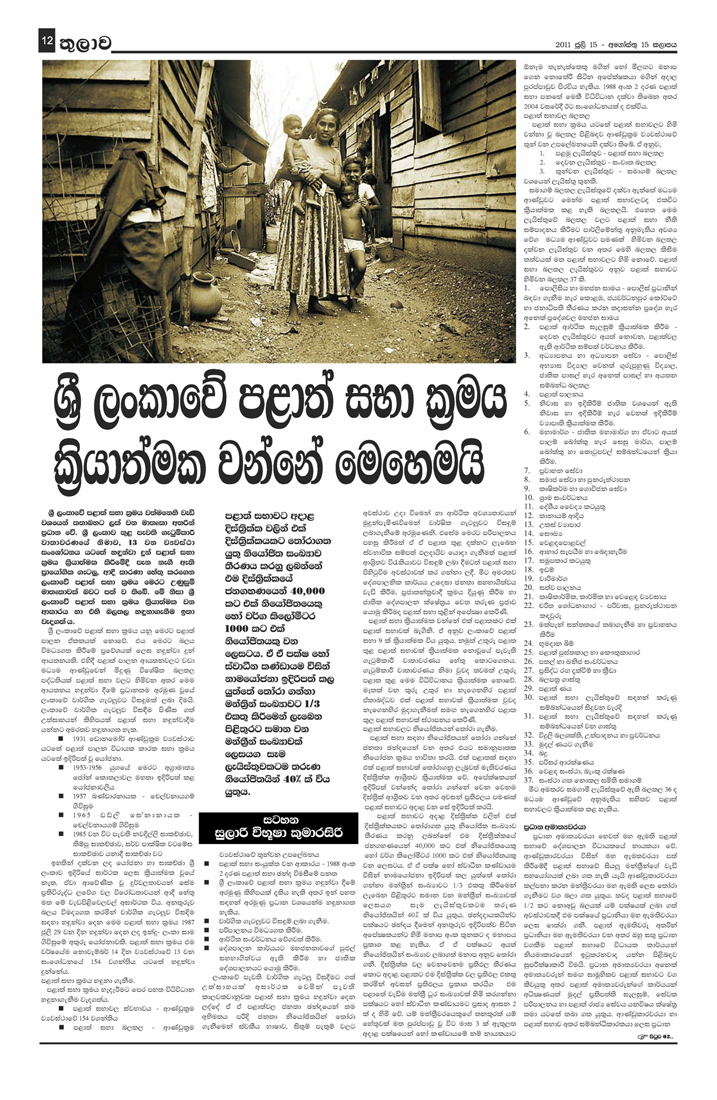
One reason why it has been able to achieve this is because of its staff that hails from different backgrounds - whether it be professors, retired local council statesmen or youth leaders. Each staff member has his/her area of expertise. While there are those who are able to write grant proposals to please the most prestigious of donors like the European Union, NPC also possess a strong team that is capable of mobilizing the masses into community action. This is largely due to their years of work at the grass roots level in various communities across the country. It also has a vibrant media wing which publishes its own news paper by the name of “Thulawa.” The NPC is a highly networked civil society organization that has working relationships with Government Ministries to more localized religious leaders - an organization free of a partisan agenda.

I strongly advise any prospective students looking to intern during vacations to strongly consider NPC as a potential internship location. I ended up learning so much, thanks largely to their willingness to send me on field trips, willingness to assign me tasks that tested my research skills and my ability to engage with a diverse staff that shared differing viewpoints. In addition to that, any intern is likely to benefit from the copious amounts of knowledge and experience of the renown Harvard educated Dr. Jehan Perera who has become a must have interview for any student studying the ethnic conflict in Sri Lanka. NPC’s large national presence from Jaffna to Galla means that it is more than likely that you would be dispatched to remote areas of the country, making an internship experience at NPC also a great way to travel across the country.